On July 27th, Citic Big Manganese rose 19.19% to HK $0.59, with a trading volume of HK $62.79 million. On the same day, the Shanghai Composite Index fell 0.07% and the Shenzhen Composite Index fell 0.02%.
Since the beginning of this year, the stock market has been less optimistic, according to a recent report in the China Securities News, 283 A-share companies have fallen below net assets, the highest level since 2008. Among them, the number of broken companies in real estate, public utilities and other industries ranks first, and the proportion of broken companies in the banking industry is high. Many broken companies actively save themselves by means of share buyback, increased shareholding by major shareholders, employee shareholding plan, equity incentive and so on.
When the green long shade line became the norm, the stock price, which rose 20% a day, was like a fireworks shell, rowing through the long-dark night sky of the stock market. At the same time as the stocks howl to each other, why on earth can the company pull up so? SMM will take a look at the company and its industry, starting with the company's earnings report.
The protagonist of the story, Citic Da mn, registered in August 2005, registered capital of 500m yuan, is a Sino-foreign joint venture, with 13 branches and holding companies, with 4500 employees, and is one of the top ten enterprises in Guangxi. The company is rich in manganese resources, accounting for 22% of the country's total reserves, ranking first in China, but also has overseas high-quality mineral resources base. Mainly engaged in manganese mining and deep processing of manganese products, the production of core products have passed the national industry access, and obtained international quality system certification, is an important supplier of global manganese products, It is the main unit for drafting and approving the national quality standard of electrolytic metal manganese, natural discharge manganese powder and chemical manganese powder.
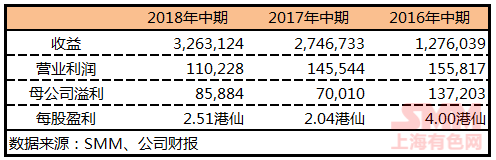
Key financial indicators: (unit: HK $1000)
Six months ended 30 June 2018
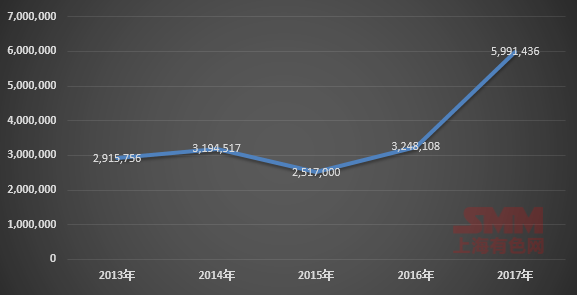
The company's earnings for the fifth year in a row: (in thousands of Hong Kong dollars)
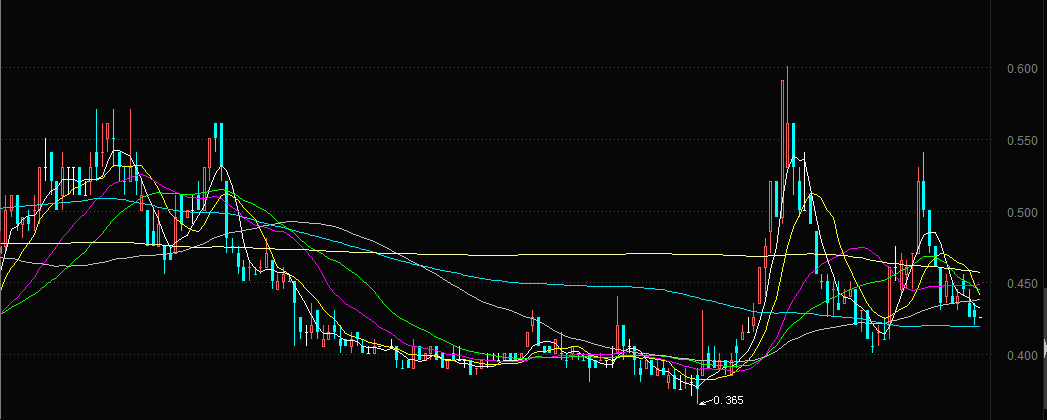
Stock price performance: (last three years)
The Source of Manganese Industry: manganese Mine
Manganese and its compounds are used in all aspects of the national economy, the largest and most important field is the iron and steel industry. According to statistics, 90% of manganese is used as deoxidizer and desulphurizer in ironmaking and steelmaking process. The remaining 10% to 5% of manganese is used in the chemical industry (manufacturing various manganese salts), light industry (for batteries, matches, printing paint, soap, etc.), building materials industry (colorants and fading agents for glass and ceramics), defense industry, electronics industry, As well as environmental protection, agriculture and animal husbandry and so on.
SMM believes that although the reserves of manganese ores are relatively rich in the world, the medium and high grade manganese oxide ores suitable for the production of manganese alloys are mainly concentrated in a few countries, such as South Africa, Australia, Gabon, Brazil, and so on. Therefore, from the perspective of the resource supply pattern of manganese mines, the giants that control the mines in these countries will occupy a leading position for a long time.
The general distribution of manganese deposits in the world accounts for:
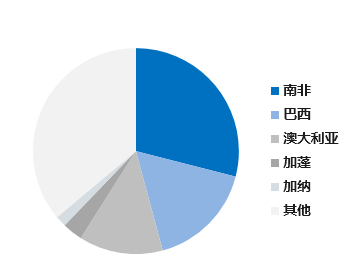
(countries with large reserves but low manganese ore grades are omitted)
Generally speaking, manganese ores are divided into two types, namely manganese carbonate ore and manganese oxide ore. The main difference between them lies in whether the manganese oxide ore is oxidized, and the surface of the manganese oxide ore is exposed, while the non-oxidized manganese carbonate ore is in the deep. The grade of manganese oxide ore is usually high.
The manganese ore in China is mainly manganese carbonate ore, the main producing area is Guangxi, Guizhou, Hunan and Chongqing, and the secondary producing area is Hubei, Yunnan and Xinjiang. Hunan Huayuan, Guizhou Songtao and Chongqing Xiushan are called "manganese triangle" because of their rich resources. Manganese carbonate ore is the main raw material for the production of electrolytic manganese. According to SMM investigation, manganese enterprises in southern China often use domestic manganese carbonate ore for production, only a few enterprises will consider using Ghanaian manganese carbonate ore when the ore supply is insufficient. The largest production enterprise in the north is located in Ningxia, where there are no manganese resources, has been using imported Ghana manganese ore for electrolytic manganese production, and completed the acquisition of Ghana manganese carbonate supplier Australia United Mining (CML) in 2017.
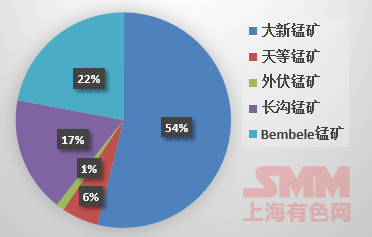
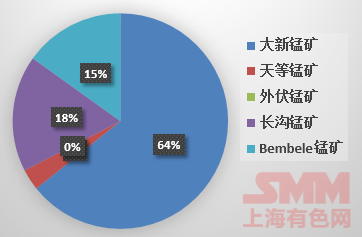
In China, the top manganese resource is Citic Daiman, which has five manganese deposits, namely, Daxin Manganese Mine, Tiandao Manganese Mine, Changgou Manganese Mine and Bembele Manganese Mine. Citic Big Manganese Mine has a total of 124.17 million tons of manganese ore resources, including Daxin Manganese Mine, Tiandao Manganese Mine, Changgou Manganese Mine and Citic Manganese Mine, which have a total of 124.17 million tons of manganese ore resources. The total reserves of manganese ore are 99.18 million tons, of which the resources of Daxin Manganese Mine as of December 31, 2017, reached 66.9 million tons, accounting for more than half of the total resources of more than five mines, and the manganese ore resources reached 63.72 million tons. 64%.
Daxin Manganese Mine was discovered in 1958. Daxin Manganese Mine and Tien Manganese Mine are located in an area in Guangxi which is famous for its rich manganese mineralization belt. The region has a subtropical climate with an average temperature of 20 degrees Celsius. The annual rainfall ranges from 135 cm to 192 cm. Daxin Manganese Mine is located in the mountainous area, at an altitude of 241 to 845 meters. According to the SRK report, Daxin Manganese Mine is the largest manganese ore in China. Daxin Manganese Mine and its related processing facilities are located about 50 km west of Daxin County in Guangxi and 210 km west of Nanning, the capital of Guangxi. The Daxin manganese mining area is located in the southeast of the inclined layer of the Shangyin-Xialei large slope, which is inclined from west to east, with a low axial angle, pointing to the east, about 9 km long and 2 to 2.5 km wide. Three manganese ore deposits are determined in the mining area, which are sustained, stable and parallel to each other. Manganese oxide ore is located in the upper half of the orebody, while manganese carbonate ore is located in the deep layer of the orebody. Manganese oxide ore is easier to mine and more economical than manganese carbonate ore. Open pit mining and underground mining are carried out in Daxin Manganese Mine. Opencast mining is carried out in four mining zones. The company has obtained the legal and valid right to carry out mining operations in the areas covered by the mining license of Daxin Manganese Mine, as well as the right to use the land covered by the Mining license of Daxin Manganese Mine. On December 31, 2011, according to JORC standard, the manganese ore reserves of Daxin manganese ore is about 72920000 tons of manganese ore, with an average manganese grade of 19.11%.
Details of the grade of five manganese ore resources: (as of December 31, 2017)
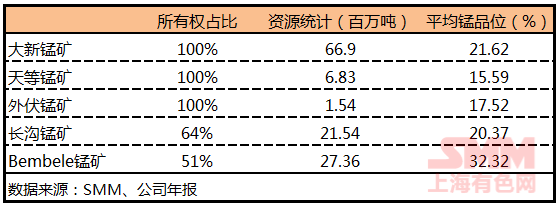
The distribution proportion of five manganese ore resources is as follows:
Details of Resource Grade of Manganese Ore reserves in five blocks: (as of December 31, 2017)
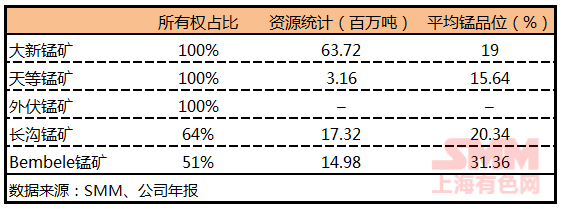
The distribution proportion of manganese ore resources in five blocks is as follows:
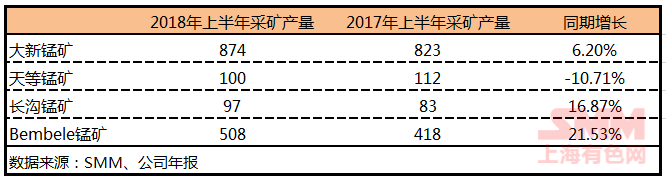
Mining activities, according to the latest data, Citic Daxin Manganese Mine in the first half of 2018, Daxin Manganese Mine total mining 874 kilotons, Tiandao Manganese Mine 100 kilotons, Changgou Manganese Mine 97 kilotons, Bembele Manganese Mine 505 kilotons.
Manganese mining output data:
Second, the processed products of manganese industry
Product 1: electrolytic manganese
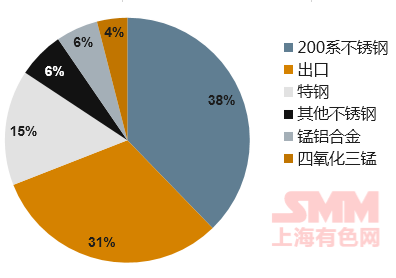
Electrolytic manganese refers to the manganese salt obtained by acid leaching of manganese ore and sent to the electrolytic cell to precipitate the simple metal. Because manganese can improve the strength, toughness, wear resistance and corrosion resistance of the alloy, it is often used to increase the hardness of metal materials. The most widely used are manganese copper alloy, manganese aluminum alloy, 200 series stainless steel, of which 200 series stainless steel has the greatest demand for electrolytic manganese. In 2017, the domestic iron and steel industry (including stainless steel and special steel) accounted for about 86% of the domestic downstream demand for electrolytic manganese. The purchase of electrolytic manganese in overseas market is mainly used in the production of special steel and high silicon steel.
Domestic Electrolytic Manganese Market demand structure in 2017:
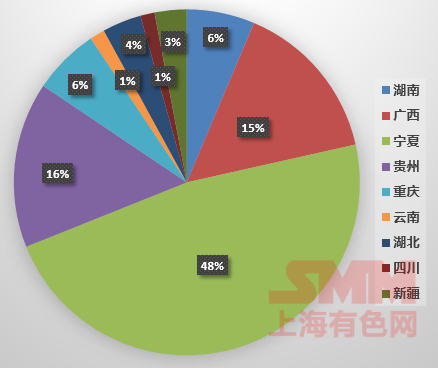
In the electrolytic manganese industry in China, the production enterprises are mainly distributed in Hunan, Guangxi, Ningxia, Guizhou and Chongqing. According to the statistical data of the annual output in 2017, the five provinces account for 90.64% of the whole country, and in these five provinces, Ningxia has the highest output of electrolytic manganese, of which Ningxia Tianyuan is basically the output of Ningxia Tianyuan, which also makes Ningxia Tianyuan the largest electrolytic manganese manufacturer in China, and the second largest number is located in Citic Big Manganese in Guangxi.
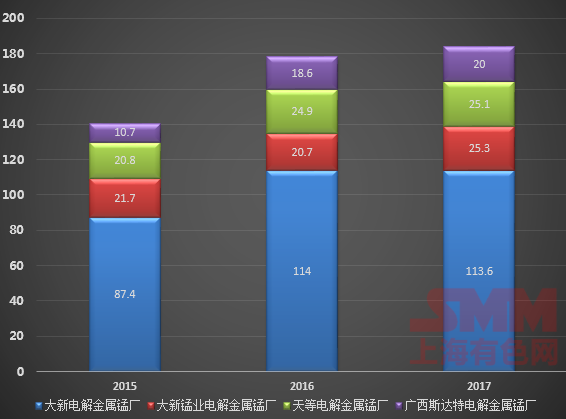
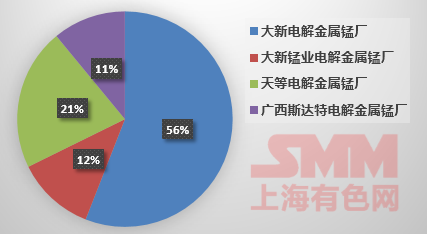
According to the annual reports of Citic Big Manganese, its electrolytic manganese production in 2017 was 184,000 tons, up from 178.2 thousand tons last year, an increase of 3 percent over the same period last year. According to the latest data, Citic Big Manganese produced 89.2 thousand tons of electrolytic manganese in the first half of this year, of which Daxin Electrolytic Manganese Plant accounted for 49.9 thousand tons, accounting for 56 percent of the total.
Annual output of Electrolytic Manganese plants under CITIC Big Manganese:
Citic Manganese Electrolytic Manganese production in the first half of 2018:
Product 2: electrolytic manganese dioxide
Manganese dioxide is a black amorphous powder, or black rhombohedral crystal, which is very useful in organic chemistry and is often used as a depolarizer for dry cells and as a catalyst and oxidant for the synthesis of industrial materials. Colorants, decolorizers and iron removal agents for the glass and enamel industries, etc., for the manufacture of metal manganese, special alloys, manganese iron castings, gas masks and electronic materials such as ferrites, etc., in addition, the production of manganese, special alloys, manganese iron castings, gas masks and electronic materials such as ferrites, etc., Manganese dioxide can also be used in the rubber industry to increase the viscosity of rubber and as a catalyst in chemical experiments. But it is the battery materials business that has sprung up in recent years that has sent manganese dioxide directly to high prices.
Electrolytic manganese dioxide is an excellent depolarizer for batteries. Compared with the dry cells produced by natural discharge manganese dioxide, it has the characteristics of large discharge capacity, strong activity, small volume, long life and so on. The discharge capacity of the dry battery made of 20-30%EMD is 50 to 100% higher than that of the dry cell made of all natural MnO2, and the discharge capacity of the dry battery mixed with 50-70%EMD can be increased by 2 to 3 times. The discharge capacity of alkaline manganese dioxide battery made entirely of EMD can be increased by 5 to 7 times, so electrolytic manganese dioxide has become a very important raw material in battery industry.
The production and marketing of manganese dioxide also plays a very important role in manganese enterprises. SMM has conducted statistics on manganese-related listed companies and found that this year, manganese enterprises generally have a strong net profit. One of the main factors is that the price of manganese dioxide continues to rise. "Click to view the comprehensive analysis report of SMM on the interim financial report of manganese enterprises in 2018
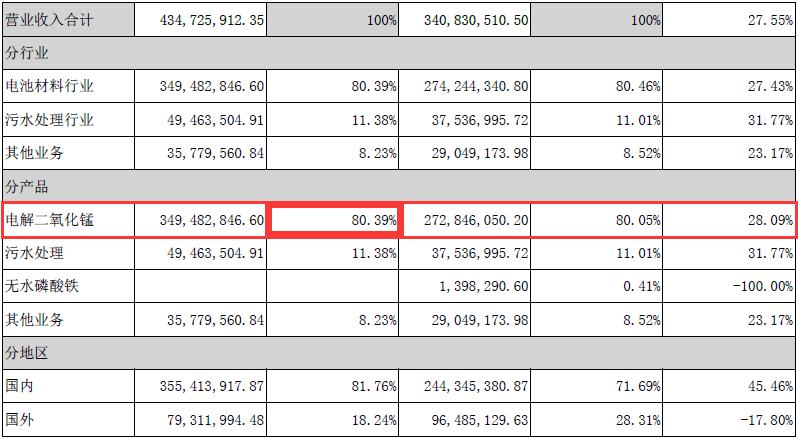
According to Xiangtan Electrochemical's interim financial report for 2018, in the first half of 2018, the production of the two electrolytic manganese dioxide plants of the company was continuously and steadily running at full load, and with the continuous expansion of the company's scale and the gradual embodiment of the advantages of product research and development, Profitability has improved steadily. From January to June 2018, the company's electrolytic manganese dioxide business achieved business income of 349.4828 million yuan, an increase of 27.43 percent over the same period last year, of which lithium manganate special type realized business income of 66.6925 million yuan, an increase of 85.11 percent over the same period last year. During the reporting period, a total of 41751.29 tons of electrolytic manganese dioxide were produced, an increase of 50.48 percent over the same period last year, and a total of 37195.21 tons of electrolytic manganese dioxide was sold, an increase of 24.10 percent over the same period last year.
Xiangtan Electrochemical Electrolytic Manganese dioxide products accounted for nearly 80% of the total revenue in the first half of 2018:
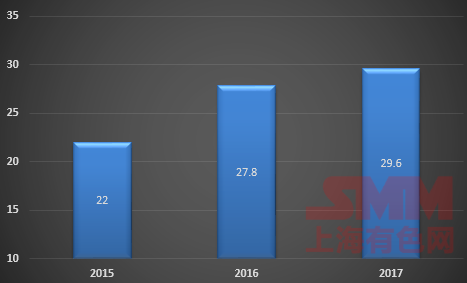
In the past three years, the output of Citic large manganese electrolytic manganese dioxide products has also increased year by year. As of the latest data, Citic Big Manganese Electrolytic Manganese dioxide was 15.7 kilotons in the first half of 2018.
Citic large Manganese production of Electrolytic Manganese dioxide in the past three years: (unit: 1000 tons)
Product 3: Silicon manganese alloy
Silicon-manganese alloy is an alloy composed of manganese, silicon, iron and a small amount of carbon and other elements. Silicon-manganese alloy is not only a common compound deoxidizer for steelmaking, but also a reductant for the production of metal manganese by low-carbon Ferro-manganese and electrosilicothermic method.
Since July last year, silicon and manganese production has been reduced due to environmental problems, but starting this year, with the gradual contact of environmental protection departments, enterprises that had previously stopped production began to resume production gradually. Due to the influence of the early water penetration process news, Si-mn has once become the focus of the market.
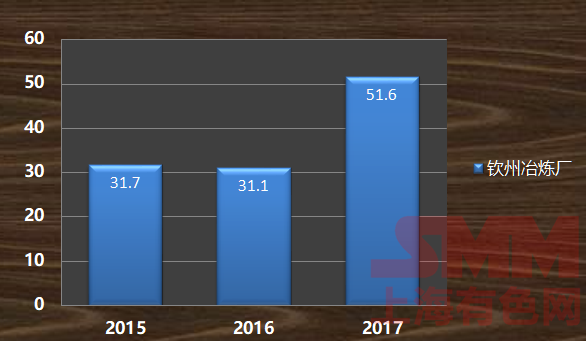
Also take Citic's Si-mn alloy production as an example, Si-mn production increased by a certain extent in 2017, with output of 28.9 kilotons in the first half of this year, up 70 percent from 16.8 kilotons last year.
Citic large Manganese Electrolytic Silicon Manganese production in the past three years: (unit: 1000 tons)
Product 4: lithium manganate
Lithium manganate is mainly spinel lithium manganate. Spinel lithium manganate LiMn2O4 is a cathode material with three-dimensional lithium ion channel first prepared by Hunter in 1981. Up to now, it has been paid great attention by many scholars and researchers at home and abroad. As an electrode material, it has the advantages of low price, high potential, environmental friendliness and high safety performance. It is the most promising cathode material to replace lithium cobalt acid LiCoO2 as a new generation of lithium ion battery.
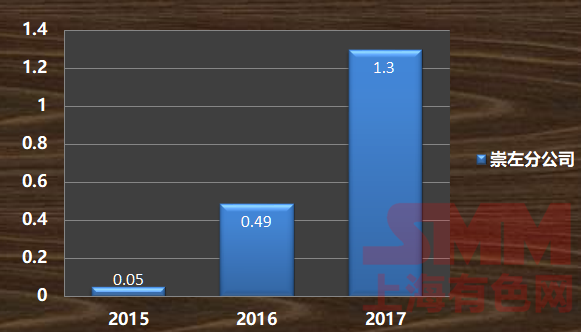
Citic's lithium manganate production increased significantly year by year, with 1.2 kilotons in the first half of 2018, compared with 0.45 kilotons in the same period last year, a substantial increase of 167 per cent.
Citic large manganese production of lithium manganate in the past three years: (unit: 1000 tons)
Product 5: manganese peach
Manganese peach, shaped like a peach or pillow, is called manganese peach. It is a new type of manganese product produced by model forging and rolling with manganese powder as the main raw material and adding some materials to change its properties. Often used in the allocation of manganese elements in special steel and stainless steel alloy industries, because of its high recovery rate, easy preservation, easy handling, accurate measurement, low dissolution temperature, rapid dissolution, stable, smokeless and pollution-free molten steel, and does not form molten slag, And well received by the market.
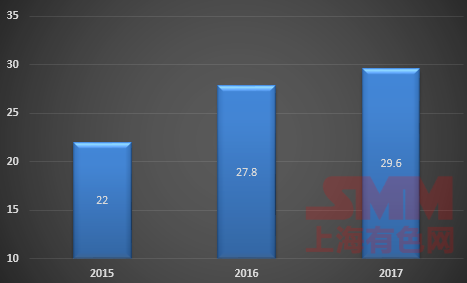
Citic manganese peach production increased year after year, its manganese peach output reached 22.1 thousand tons in the first half of 2018.
Annual output of manganese peach under CITIC Big Manganese flag: (unit: 1000 tons)
Product 6: sulfuric acid
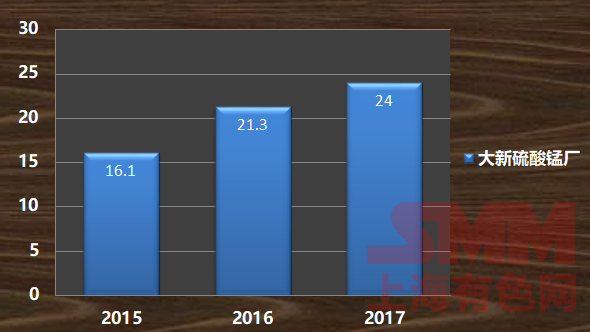
Manganese sulfate is a trace element needed by crops to synthesize fatty acids, so manganese sulfate can be used as fertilizer to increase production in soil. The addition of manganese sulfate to animal feed has the effect of fattening. Manganese sulfate is also a raw material and analytical reagent for the preparation of other manganese salts. Manganese sulfate is also used in the industrial production of electrolytic manganese, dye, papermaking and ceramics.
Annual production of Manganese Sulfate under CITIC Big Manganese: (unit: 1000 tons)
How was the sales of manganese products in the first half of March?
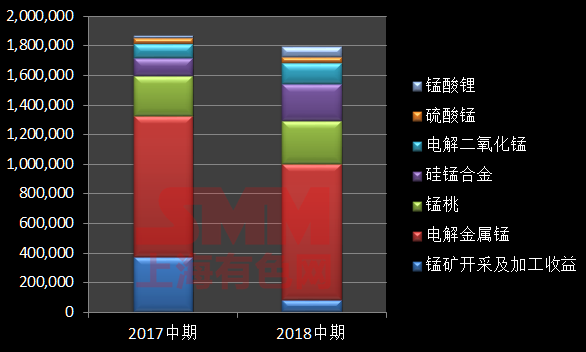
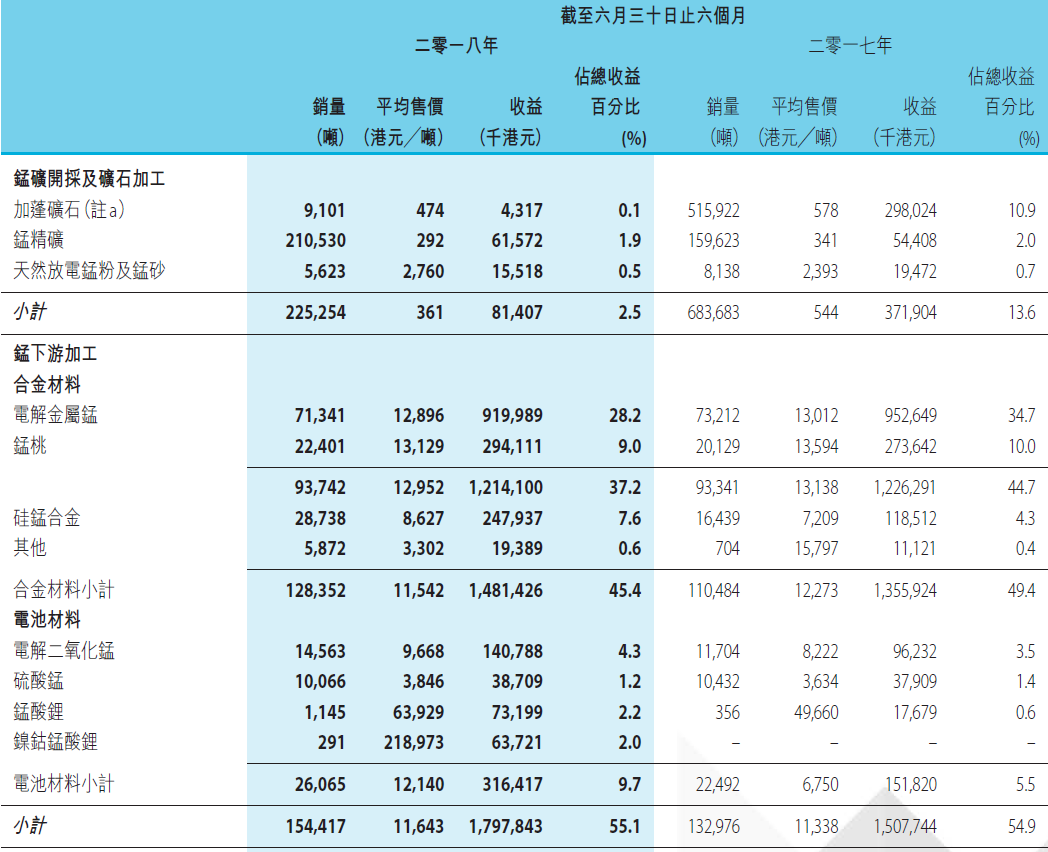
Citic manganese, for example, earned HK $81407, 000 from manganese mining and processing in the first half of the year, down 78.1% from HK $371904 in 2017, mainly due to a decline in sales of ore from Gabon in the first half of the year. The main product electrolytic manganese is slightly reduced, the company believes that the market continues to stagnate because of the overall steel output, and the production capacity and output of electrolytic manganese are saturated with the first half of 2018, so the income of electrolytic manganese changes gently.
In terms of Si-mn alloys, earnings increased by 109.2% for two main reasons: first, since the second half of last year, the company has increased its production of Si-mn alloys as a result of the recovery of the alloy market, resulting in sales rising to 28738 tons in the first half of 2018. It rose 74.8% over the same period. Second, the average sales price of Si-mn alloy rose to HK $86237 per tonne in the first half of 2018, an increase of 19.7 per cent over the same period.
Comparison of income from manganese and its processed products over the same period: (unit: Hong Kong dollar)
Product revenue, sales volume and selling price:
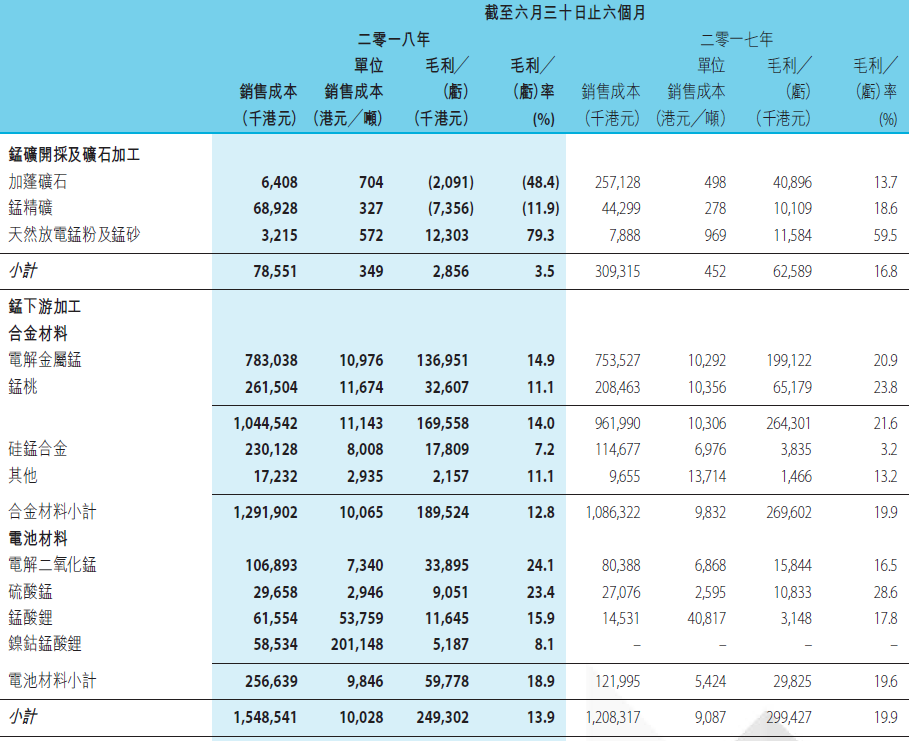
Product sales cost, unit sales cost, gross profit margin:
Citic Da mn's forecast and prospect for the future of the industry:
Macro: 2018 follows the strong global economic momentum in 2017, and the upward trend of global economic growth is expected to remain unchanged. However, the global economy is being affected by the following factors in the short term. In the United States, tax reform is expected to reduce corporate income tax and stimulate corporate investment in the short term. At the same time, higher-than-expected inflation accelerated the normalization of US interest rates, raising financing prices for companies and raising the likelihood of market adjustments for high-value assets. On the Chinese side, since 2017, the economy has shown signs of stability and improvement. However, in the short to medium term, world trade is being damaged by the haze of the recent Sino-US trade war. The macro-economy in 2018 is still fraught with uncertainty.
Steel industry: through the successful implementation of supply-side reforms in 2017, the entire steel industry benefited in the first half of this year. On the other hand, the cooling of real estate investment limited the rise in steel prices and demand in the first half of 2018. In the short to medium term, steel demand growth is mainly due to government-led infrastructure investment and manufacturing upgrading, and the growth will be relatively moderate, due to the expected increase in deleveraging activities in the financing market. And the economy has matured and begun to shift its focus from manufacturing to consumption and services. It is expected that the steel market demand will only be stable in 2018, and the industry will still be full of challenges in the future.
Battery materials industry: with the rapid growth in production of portable electronic products, hybrid and electric vehicles and other energy storage devices in recent years, the market demand for battery materials is growing rapidly. In response to the strong demand for battery materials on the market, Citic Manganese began to cautiously expand the production capacity and product range of battery material products (mainly electrolytic manganese dioxide, manganese sulfate, lithium manganate and line cobalt lithium manganate) in 2016:
1. The company began investing in the production of lithium nickel cobalt manganate in 2016, and in the second half of 2017, the production line of lithium nickel cobalt manganate began commercial production and contributed to revenue growth in the first half of 2018.
2. As the price of lithium cobalt has soared since 2017, some data battery manufacturers have stepped up other materials to replace lithium cobalt to save costs. Accordingly, the company converted the production line of lithium cobalt to the production of lithium manganate in 2018.
3. Starting in the second half of 2017, the company built two plants to produce lithium manganate at the high-tech Chongzuo base. The first plant began commercial production in late June 2018, and the second plant will begin commercial production in mid-2019.
In terms of performance contribution, the revenue of battery materials products in the first half of 2018 was HK $316 million, up 58.3% from HK $199.9 million in the same period, and the gross profit contributed HK $5980 million, compared with HK $4270m in the same period, up 39.9 per cent over the same period.
Cost: the company strives to reduce unit production costs and maintain competitiveness in the manganese industry by improving production processes and conducting constant negotiations with upstream suppliers on raw material prices and energy consumption. The unit production cost ratio of major products remained stable in the first half of 2018. Citic Manganese will continue to look for ways to improve production efficiency and control costs. To sum up, due to the fall in the market price of manganese products, the gross profit margin and gross profit contribution of the company's main products electrolytic manganese and manganese peaches decreased in the first half of 2018 compared with the same period last year.
"Click to view details